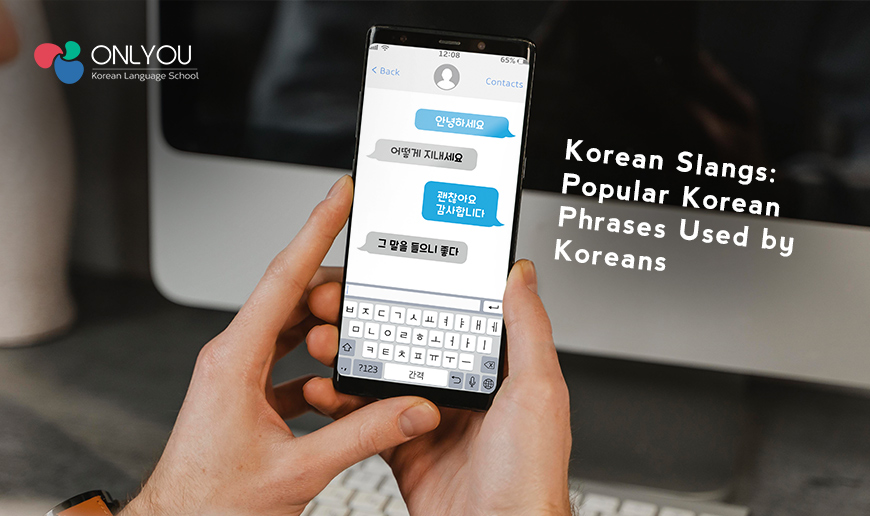
Korean Slangs: Popular Korean Phrases Used by Native Koreans

Korean Slangs Popular Korean Phrases Used by Native Koreans

People from different countries speak, read, and write in different ways even if they speak the same language. Singaporeans, for example, primarily use singlish and acronyms for casual communication.

Many young Koreans today also use slang in everyday conversations; it is a group of usually informal words, phrases, or expressions that are used to express feelings and describe things and places. In addition to taking Korean classes at a Korean language centre, learning Korean slang is a great way to improve your Korean language skills. It will not only improve your listening skills, but it will also allow you to sound more like a native when speaking Korean. Forging friendships with Korean people will become easier, Korean jokes will become easier to laugh along to, and Korean movies and songs may also be easier to understand.

In this article, we share some common Korean slang words so you can learn and understand what some of your Korean friends are saying.

꿀잼 (kkul-jaem)

How it’s used: “이 게임이 꿀잼이다 (i ge-im-i kkul-jaem-i-da): This game is so much fun”

This word can be used to describe events or activities that are enjoyable or interesting. 꿀 (kkul) means “honey” while 잼 (jaem), with the same pronunciation as the English word “Jam”, is a shortened version of the word 재미있어요 (jae-mi-iss-eo-yo), which means interesting. This slang, “Honey-Jam”, is commonly used by younger people to describe something being fun and enjoyable.

노잼 (no-jaem)

How it’s used: “이 게임이 노잼이다 (i ge-im-i no-jaem-i-da): This game is not fun”

노잼 (no-jaem) is the opposite of 꿀잼 (kkul-jaem), which means something is not fun or not funny. The slang breaks down into it’s literal meaning with “” means “no” while “” means “fun”.

까비 (kka-bi)

How it’s used:까비! 음료수를 다 쏟았다 (kka-bi! eum-lyo-su-leul da ssod-att-da): What a waste! I spilled all my drinks”

까비 (kka-bi) is a colloquial term for 아까비 (a-kka-bi) which is another colloquial term for the word ‘아깝다’ (a-kkab-da), which means “what a waste”.

극혐 (geug-hyeom)

How it’s used: “냄새 극혐이다 (naem-sae geug-hyeom-i-da): This smells terrible”

극혐 (geug-hyeom) is a shortened version of the phrase 한의 오 (geug-han-ui hyeom-o) which translates to “extreme hatred.” It is used when you have seen something that disgusts you or something that you despise.

 (heol)

How it’s used:, 대박! (heol, dae-bak!): OMG, Amazing!”

헐 (heol) is a common exclamation used to express shock or surprise. It is similar to how OMG is used in English, and it is most often used in texting.

레알 (le-al)

How it’s used:레알 맛있다 (le-al mas-it-da) : It’s really delicious”

When spoken in Korean, this word has the same phonetic pronunciation as the word “real” in English. It has the same definition as well. 레알 (le-al) is used to give emphasis and focus. It is commonly used in place of intensifiers such 진짜 (jin-jja)really.

그린라이트 (geu-lin-la-i-teu)

How it’s used: “카페에서 처음 만난 그와 요새 그린라이트다 (ka-pe-e-seo cheo-eum man-nan geu-wa yo-sae geu-lin-la-i-teu-da): I met him at a cafe for the first time and he is giving me the green light these days”

This word means “Green Light,” and it holds the same phonetic pronunciation as the English word. However, it does not refer to the traffic light. It can be used to describe someone who expresses romantic interest in you.

역대급 (yeog-dae-geub)

How it’s used: “올해 라인업은 역대급이다 (ol-hae la-in-eob-eun yeog-dae-geub-i-da) : This year’s lineup is the best ever”

This phrase translates to “unprecedented” or “legendary level” and is used to describe someone or something that is the best of all time. 역대 (yeog-dae) means in history while 급 (geub) means class. When put together, the word means “the best class ever seen in history.

존맛탱 (jon-mat-taeng)

How it’s used: “우와, 이거 존맛탱이다 (u-wa, i-geo jon-mat-taeng-i-da) : Wow, this is so delicious”

맛 (mat)  is the Korean word for “taste”, and the word 존맛 (jon-mat) is frequently used to describe food as being extremely delicious. The word 탱 (taeng) was added at the end of the word for a cuter expression. Today, 존맛탱 (jon-mat-taeng) is used widely to describe delicious food. You may also see it being written as “JMT.”

강추 (gang-chu)

How it’s used: “이 식당을 강추합니다 (i sig-dang-eul gang-chu-hab-ni-da.) : I strongly recommend this restaurant”

This word is used when you’d highly recommend something or a place. It is made up of two Korean words: 력 (gang-lyeog), which translates to “strong” and 천하다 (chu-cheon-ha-da), which means “to recommend.” When combined, the word 강추 (gang-chu) means strongly recommend.

These Korean slang words can be used in a variety of situations and are useful when you want to express yourself but don’t know how. We hope this article has given you a better understanding of the Korean language and how Korean slang is created.

Want to learn the Korean language? ONLYOU is a Korean language centre in Singapore offering different Korean classes for beginners to advanced learners. Visit our website to find out more about our classes.

Scroll to Top