

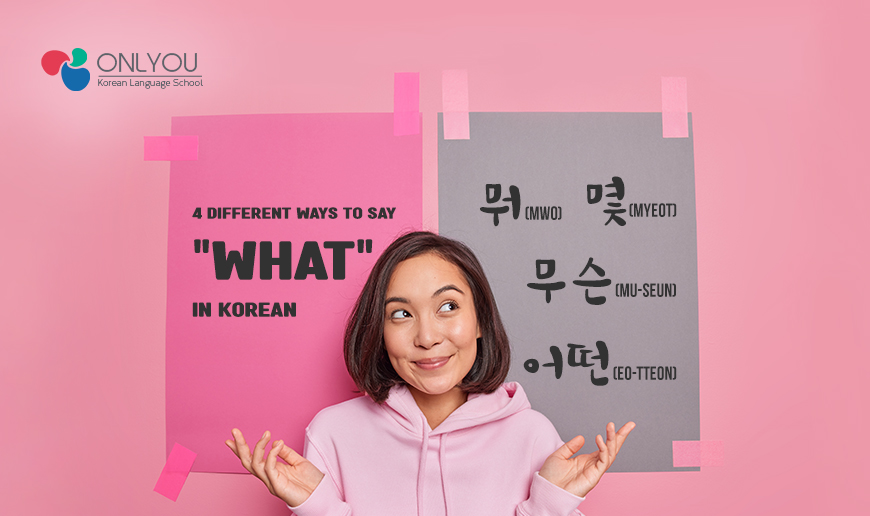
4 Different Ways to Say “What” in Korean
There are many ways to say the word “what” in the Korean language, and it is important to understand them. Learn these 4 ways to express “what” in Korean.
Whether you’re asking someone for directions, trying to figure out the definition of a word, or finding out what your friend is up to during his or her free time, the English vocabulary you’ll start your sentence with is most likely “what”.
Now, if you’d like to ask the same questions in the Korean language, you’d think that simply knowing how to say “what” in Korean will suffice. But unfortunately, that is not the case. There are so many ways to say “what” in Korean that only knowing one version will not get you far. In this article, we’ll explore the various ways “what” is expressed in Korean to help you unlock new sentences you can use in your language journey.
- What is this? — 이거 뭐 예요? (i-geo mwo ye-yo?)
- What is your name? — 이름이 뭐예요? (i-reum-i mwo-ye-yo?)
- What do you like? — 뭐 좋아해요? (mwo joh-a-hae-yo?)
- What are you studying? — 뭐 공부해요? (mwo gong-bu-hae-yo?)
- What’s the matter? — 무슨 일이에요? (mu-seun il-i-e-yo?)
- What song do you like? — 무슨 노래 좋아해요? (mu-seun no-lae joh-a-hae-yo?)
- What day is it today? — 오늘 무슨 요일이에요? (o-neul mu-seun yo-il-i-e-yo?)
- What kind of work are you doing? — 무슨 일을 하세요? (mu-seun il-eul ha-se-yo?)
- What kind of person is he/she? — 그 사람 어떤 사람이에요? (geu sa-lam eo-tteon sa-lam-i-e-yo?)
- What book are you looking for? — 어떤 책을 찾아요? (eo-tteon chaeg-eul chaj-a-yo?)
- What do you want to watch? — 어떤 것을 보고 싶어요? (eo-tteon geos-eul bo-go sip-eo-yo?)
- What time is it? — 몇 시예요? (myeot si-ye-yo?)
- What floor is it? — 몇 층 이에요? (myeot cheung i-e-yo?)
- How many people are there? — 몇 분이세요? (myeot bun-i-se-yo?)
Learn More: Korean Counting System: Sino-Korean and Native Korean
Mastering the various ways to say “what” in Korean allows you to express yourself more precisely in different social situations. And understanding the nuances and appropriate contexts for each form can enhance your Korean language proficiency and communication skills. So, practice using these expressions in your conversations to become more fluent and confident in the Korean language!

Want to learn Korean more efficiently? Sign up for a Korean language course with ONLYOU Korean, a Korean language school in Singapore, to get step-by-step guidance from a Korean teacher. Find out more here.