

Can You Read Korean? Try These 5 Easy Hangul Words!
New to Korean? Discover how Hangul works, learn to combine Korean letters into syllables and challenge yourself to read five easy Korean words!
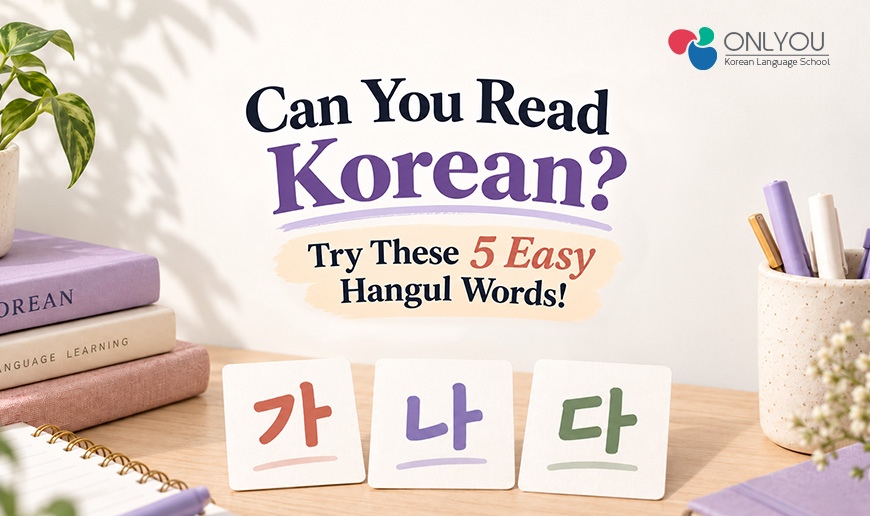
Have you ever looked at Korean writing and wondered how anyone manages to read those unfamiliar letters?
Perhaps you’ve seen Korean words in your favourite K-drama, on a K-pop album or on a restaurant menu. You might recognise a few expressions when you hear them, but reading the actual Korean letters is a different story!
Well, here’s a little challenge: What if you could learn to read Korean one syllable at a time, starting with five simple words?
We’ll introduce a few Hangul letters, show you how they fit together and let you try reading some simple words. No need to memorise everything before you begin.
Hangul (한글) is the Korean writing system. Unlike English, where letters are usually written one after another, Hangul letters are arranged into syllable blocks.
There are 14 basic consonants and 10 basic vowels. Some look alike at first, especially when you’re still learning which parts of each letter matter.
Take these vowels, for example:
The short stroke points in a different direction or sits in a different position. These small differences tell you which vowel you’re looking at.
Beginner tip: You don’t have to memorise the entire alphabet immediately. Start with a few letters, get used to their shapes and sounds, and add more over time.
Want to learn more about each letter? Explore our Beginner’s Guide to Hangul for a fuller introduction.
Here is a handy reference chart of the 14 basic Korean consonants and 10 basic vowels. You don’t need to memorise every letter before trying our five-word quiz. Use the chart to get familiar with their shapes and approximate sounds.
Wondering why a letter can have more than one romanised spelling? See the official Korean romanisation guidelines from the National Institute of Korean Language. Romanisation is a guide, not an exact match for English pronunciation.
14 basic consonants
Read the letter, then check its Revised Romanisation and sound clue.
The readings above describe common sounds, not fixed English equivalents. Consonants such as ㄱ, ㄷ, ㅂ and ㄹ can sound different depending on their position. The consonant ㅇ is silent at the start of a syllable and sounds like ng at the end.
10 basic vowels
Romanisation appears below each Hangul letter, followed by a rough English sound cue.
English sound clues and romanisation help you begin, but do not reproduce every Korean vowel exactly.
For example, 아 (a), 오 (o) and 우 (u) all begin with a silent ㅇ, allowing a vowel to form a complete syllable block.
A Korean syllable block puts its letters together in one unit. Let’s try combining a consonant and a vowel:
Consonant + vertical vowel
나 (na)
The vowel ㅏ sits to the right of ㄴ.
Try another combination:
Consonant + horizontal vowel
무 (mu)
The vowel ㅜ sits below ㅁ.
Did you notice the difference? The vowel ㅏ sits to the right of a consonant, while ㅜ sits below it. The letters still combine into a single syllable block.
Hangul syllable block rules: Where do the letters go?
Think of each syllable as a small square. Start with a consonant (C) and a vowel (V). Some syllables also have a final consonant, called 받침 (batchim). The vowel’s shape helps determine the layout.
C + V (side by side)
C + V (stacked)
C + V + C
These are three common layouts. Hangul also has combined vowels and more complex final-consonant combinations, which you can learn later.
Here comes the fun part! Look at the Korean word, try saying it aloud, then click to reveal its pronunciation and English meaning. There’s no time limit!
5 Words. Your Turn!
Sound out each word first, then click to reveal its reading and meaning.
Can you remember this one?
Reveal the answer
나무 (namu) = Tree 🌳
나 (na) + 무 (mu) = 나무 (namu)
Both syllables begin with ㅇ. Remember what that means?
Reveal the answer
우유 (uyu) = Milk 🥛
우 (u) + 유 (yu) = 우유 (uyu)
The initial ㅇ is silent.
Look carefully at the two vowels.
Reveal the answer
아이 (ai) = Child 👶
아 (a) + 이 (i) = 아이 (ai)
Familiar letters, but in a different combination!
Reveal the answer
오이 (oi) = Cucumber 🥒
오 (o) + 이 (i) = 오이 (oi)
Three syllables this time. Try reading them one at a time.
Reveal the answer
바나나 (banana) = Banana 🍌
바 (ba) + 나 (na) + 나 (na) = 바나나 (banana)
At ONLYOU Korean, we often see beginners taking a little longer in their first lessons to recognise letters that look alike. Students are learning to distinguish the shapes, remember the sounds and put both together.
And letters aren’t the only challenge. Korean also has consonant groups, such as ㄱ, ㅋ and ㄲ, that may sound quite similar to English speakers at first:
Plain consonant
Aspirated consonant, with a stronger burst of air
Tense consonant, produced with different vocal tension
These aren’t simply three strengths of the same English sound. Hearing and producing the differences takes guided practice.
Imagine seeing 나 for the first time. You might need to think: That’s ㄴ… that’s ㅏ… together, 나. After seeing the same combination many times, you can begin recognising it more readily as a complete syllable.
The aim isn’t to race through the alphabet. It’s to build familiarity, so recognising letters and combining syllables gradually requires less effort.
If you want to learn to read Korean, begin by recognising a few Hangul letters and practising them in different combinations. These three simple activities are a good next step after the quiz.
1. Spot similar-looking letters
Pick two or three letters you confuse, such as ㅏ, ㅓ and ㅗ. Write them in a different order and practise identifying each one without looking at your notes.
2. Change one letter at a time
Keep the consonant the same and swap the vowel: 나 (na), 너 (neo), 노 (no), 누 (nu). Listen to how the sounds change while the syllable pattern stays familiar.
3. Read aloud slowly
Use short syllables and words, and focus on accuracy rather than speed. As the letters become more familiar, try reading again without relying on English spellings. Feedback from a teacher is especially helpful for sounds that don’t match English exactly.
When you’re ready to practise these basics in a guided classroom setting, take a look at our Korean Foundation classes for complete beginners.
If reading your first Korean words was fun, our Foundation Korean classes in Singapore are designed to help complete beginners build on that first step.
Across eight weekly lessons, students are introduced to Hangul, Korean pronunciation, basic expressions, numbers and simple self-introductions, with time to practise and become more comfortable with the language.
| Start date | Format | Time |
|---|---|---|
| Wed, 11 Nov | In-person | 7:30–9:00 pm |
| Sat, 14 Nov | In-person | 4:00–5:30 pm |
| Tue, 17 Nov | Online | 7:30–9:00 pm |
8 lessons · 1.5 hours each · S$240